


Neuroscience · Cognitive science · Computational intelligence
The human brain lets us recognise faces, understand language, remember experiences, imagine possibilities, feel emotions, and choose how to act. Yet one of science’s central questions remains open: how does physical activity in a living system give rise to the experience of thinking?
This research journey moves from individual neurons to large-scale networks, from sensory signals to perception, from learning to memory, and from biological intelligence to computational systems inspired by it. The comparison is useful when it makes a testable question clearer; it becomes misleading when metaphor is treated as mechanism.
Chapter 01 · Cognition & experience
What happens when you think?
Interactive concept explorer · scientific explanation
Explore one part of thinking at a time
Select an idea to see how it connects with other systems. The examples clarify a concept; they do not reduce thought to a single pathway.
Scientific explanation
Thinking
Thinking does not happen in a single isolated place. It emerges from interactions among sensory systems, memory, attention, goals, language, emotion, bodily state, and action. Brain activity is the changing electrical and chemical activity of neural tissue; cognition describes processes such as remembering or planning; conscious experience refers to what it feels like to see, hear, or think. These ideas are related, but they are not interchangeable explanations.
Systems involved. Sensory systems, memory, attention, goals, language, emotion, bodily state and action.
Working example
Planning a route home can combine what you see, memories of streets, a current goal, language directions, bodily fatigue and an action choice.
Scientific boundary
No single brain area contains a complete thought; a useful explanation has to account for coordinated activity across systems.
Conceptual relationship map. The links are explanatory only and do not represent measured connectivity or a complete account of cognition.
Explicity Health Intelligence Lab · Investigation Console
Questions scientists are still investigating
Compare empirical in vivo neurophysiology against computational in silico algorithms. Scroll inside each card to inspect granular data, empirical measurements, and mathematical formulations.
Learn complex neural topics more easily
Interactive graphs, electrophysiological traces, and mathematical tensor comparisons enable researchers to investigate cognition step by step without conflating machine learning heuristics with biological neurophysiology.
Chapter 02 · Cells, synapses & plasticity
The language of neurons
A neuron is a living cell with a shape and molecular machinery suited to receiving, integrating, and transmitting signals. The soma contains the nucleus and supports cell maintenance. Dendrites and their spines receive many inputs. The axon carries signals away from the cell body; myelin around many axons alters the speed and efficiency of propagation. Axon terminals communicate with other cells at synapses.
Electrical events meet chemical communication
Neurons maintain electrical gradients across their membranes. When local conditions reach a threshold, voltage-dependent ion channels can produce an action potential. At many chemical synapses, an arriving spike opens calcium channels; calcium entry promotes vesicle release; neurotransmitters then interact with receptors on the receiving cell. The receiving response depends on transmitter, receptor, cell type, location, prior activity, and the surrounding circuit.
Excitatory and inhibitory influences help shape activity, but neural communication is not simply an on/off switch. Information can depend on spike timing and rate, which cells are active together, the state of a network, and neuromodulatory context. An action potential is often described as all-or-none; that does not make the brain a conventional binary computer. Hodgkin and Huxley’s classic membrane-current study ↗
Transmitters do not have one psychological meaning
Glutamate commonly supports fast excitatory transmission in the central nervous system, while GABA commonly supports inhibition. Dopamine participates in movement, learning, motivation, and reward-related signalling; it is not just a “pleasure chemical.” Serotonin and acetylcholine also influence multiple processes across distinct receptors and circuits. A transmitter’s effect depends on where, when, and how it acts—not a one-chemical/one-emotion rule.
Connections change with experience
Synaptic plasticity includes activity-dependent changes in the effectiveness of connections. Long-term potentiation and depression are experimentally studied forms of lasting synaptic change. Structural plasticity and changes in excitability also matter. These mechanisms help explain how experience can alter later processing, but no single cellular mechanism fully explains learning, memory, or behaviour.
Local circuits include feedback and recurrent connections. The behaviour of a network can depend on its organisation and state, not only on isolated cell properties. Questions about how different forms of plasticity coordinate over seconds, days, and years remain open.
A simulated action potential
Illustrative teaching waveform, not a recording. Channel dynamics and waveform shape vary by cell and conditions.
Chapter 03 · Anatomy & connected systems
Inside the human brain
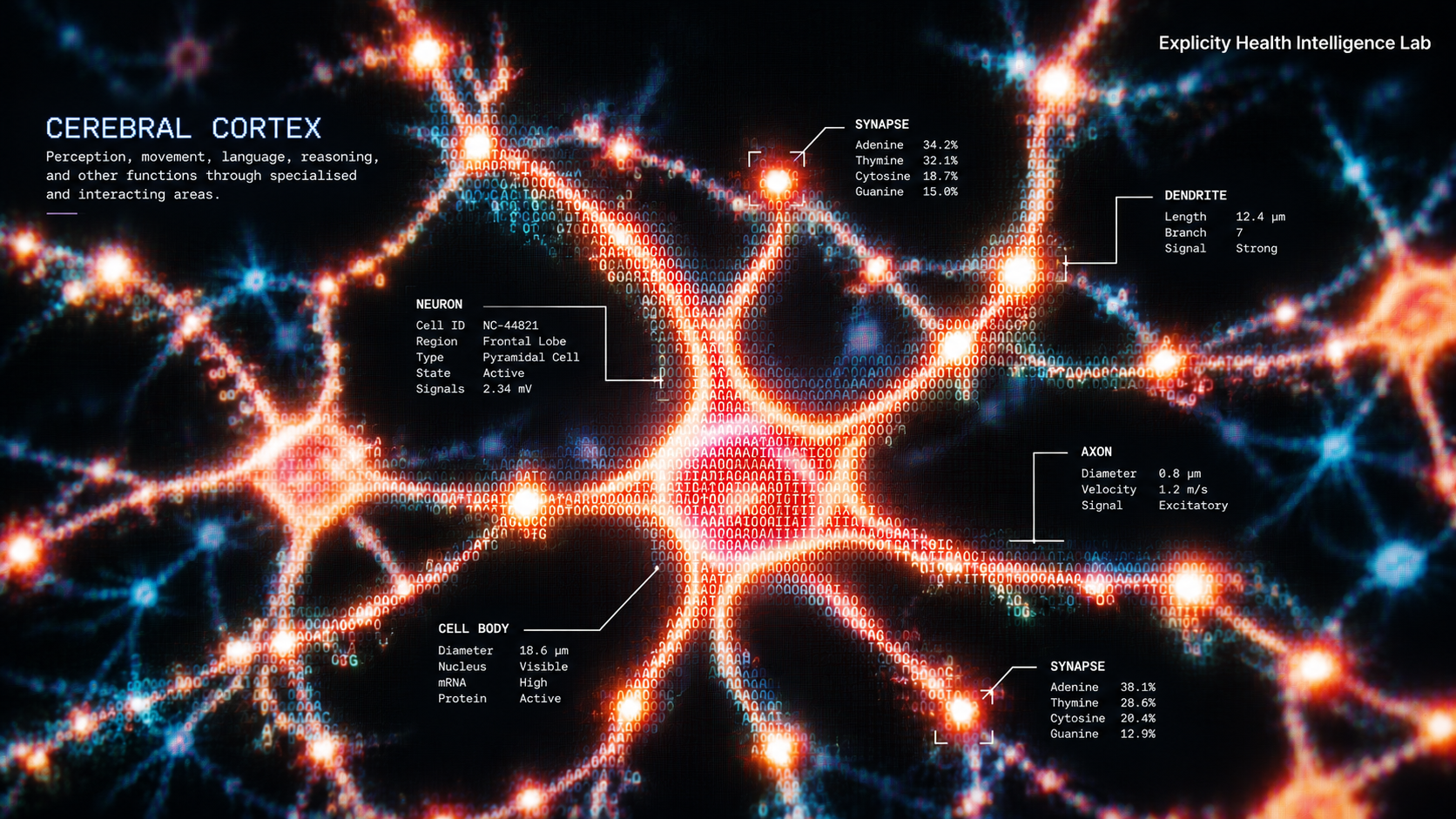
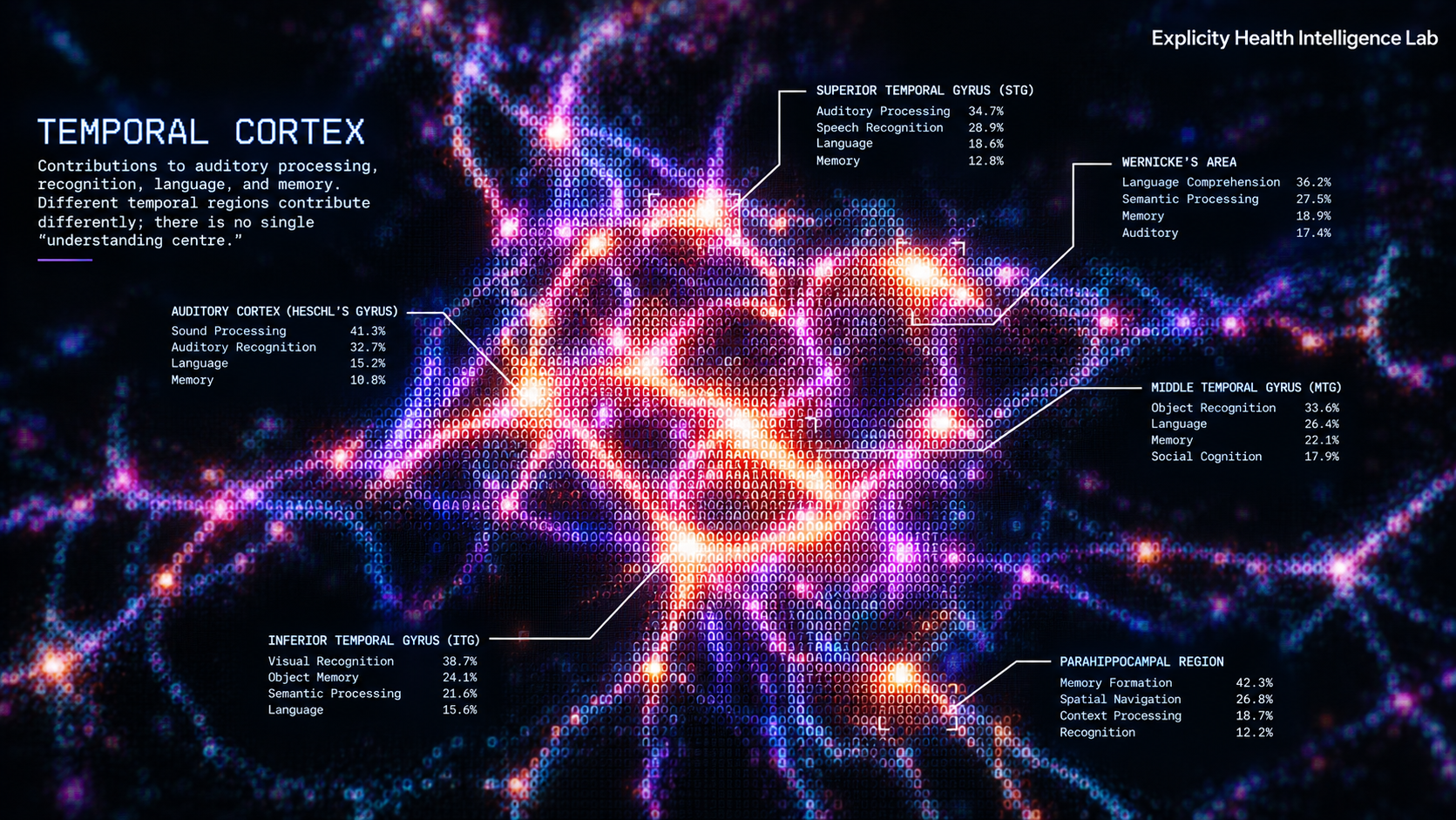
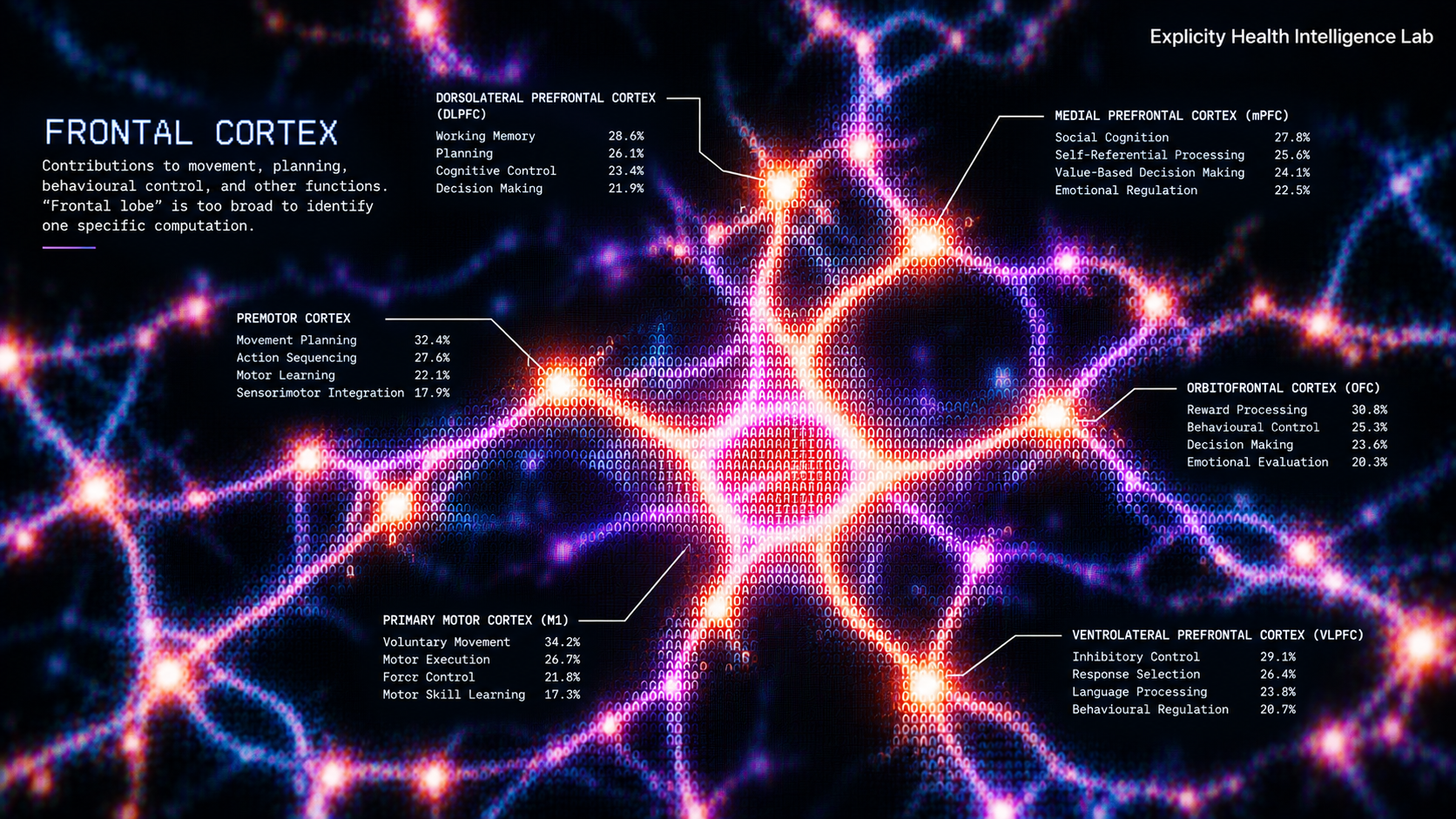
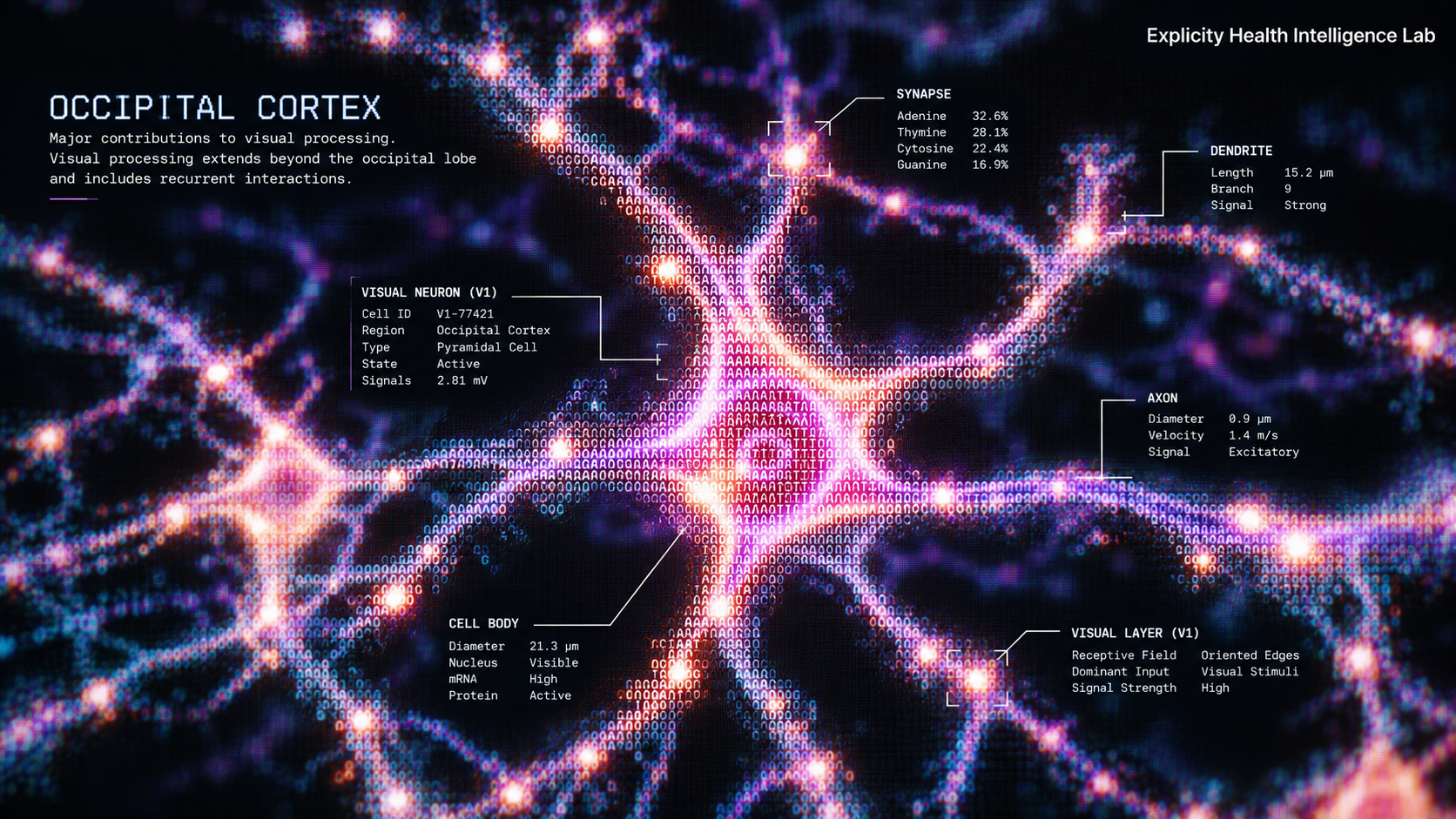
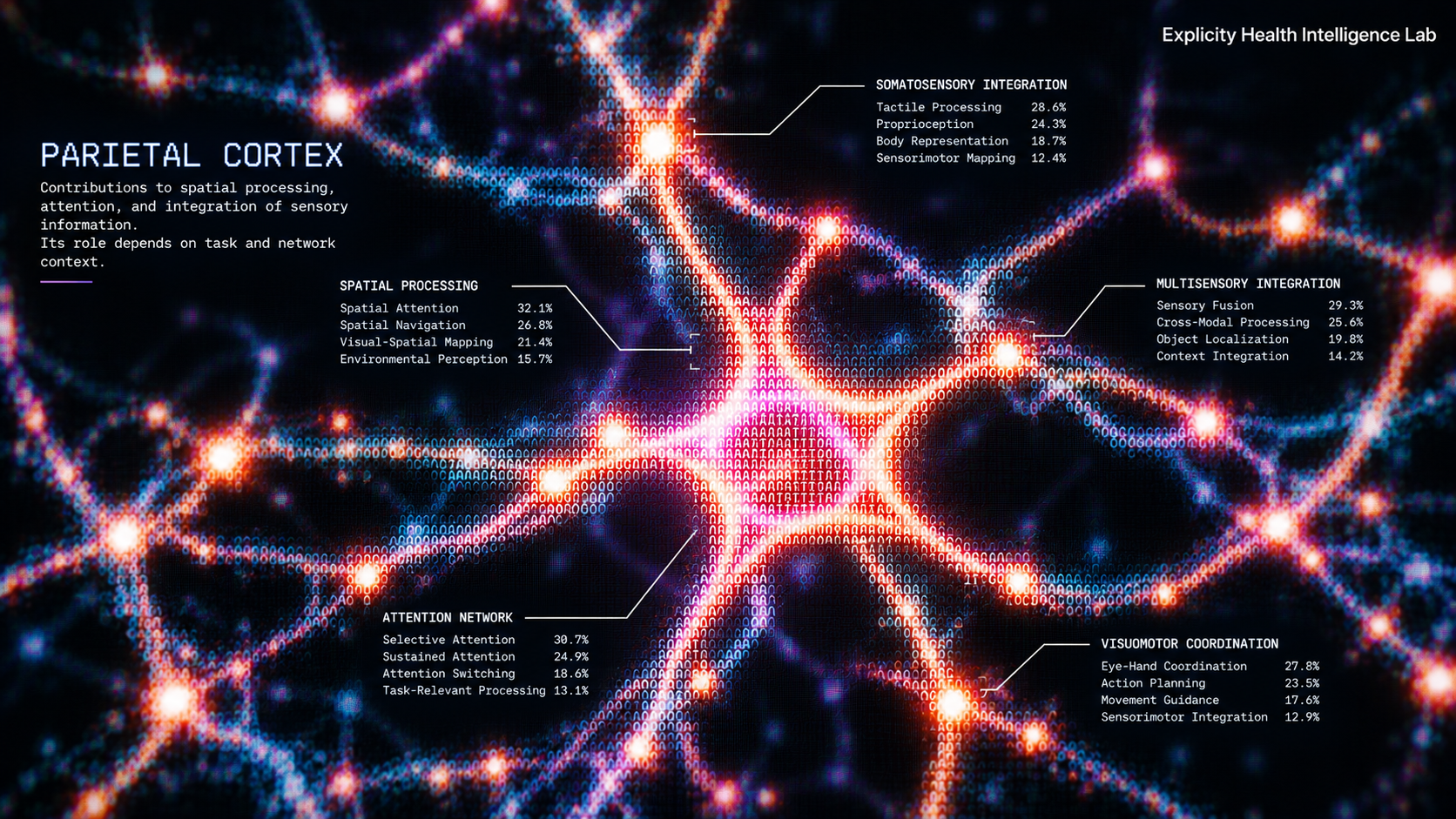
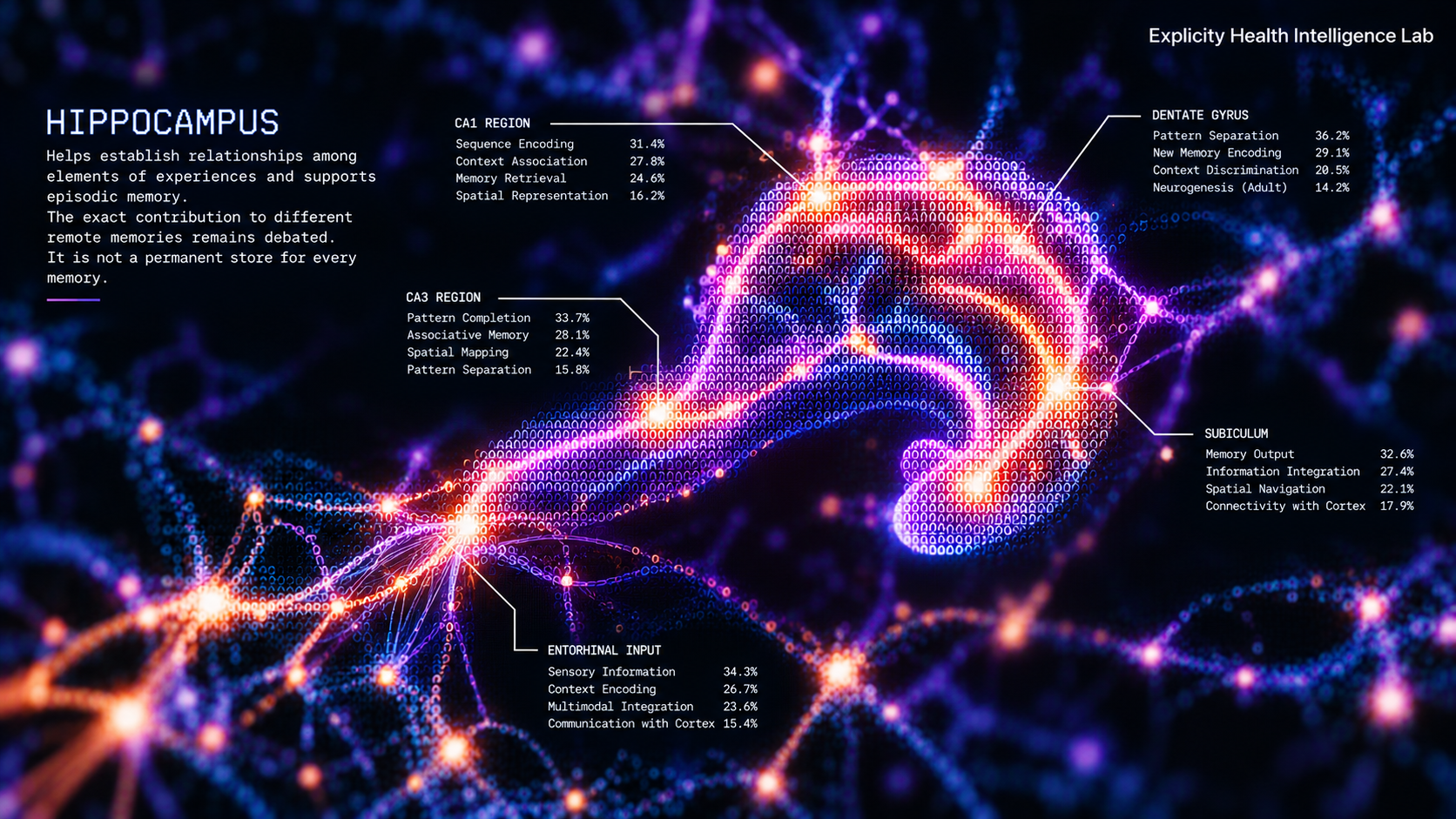
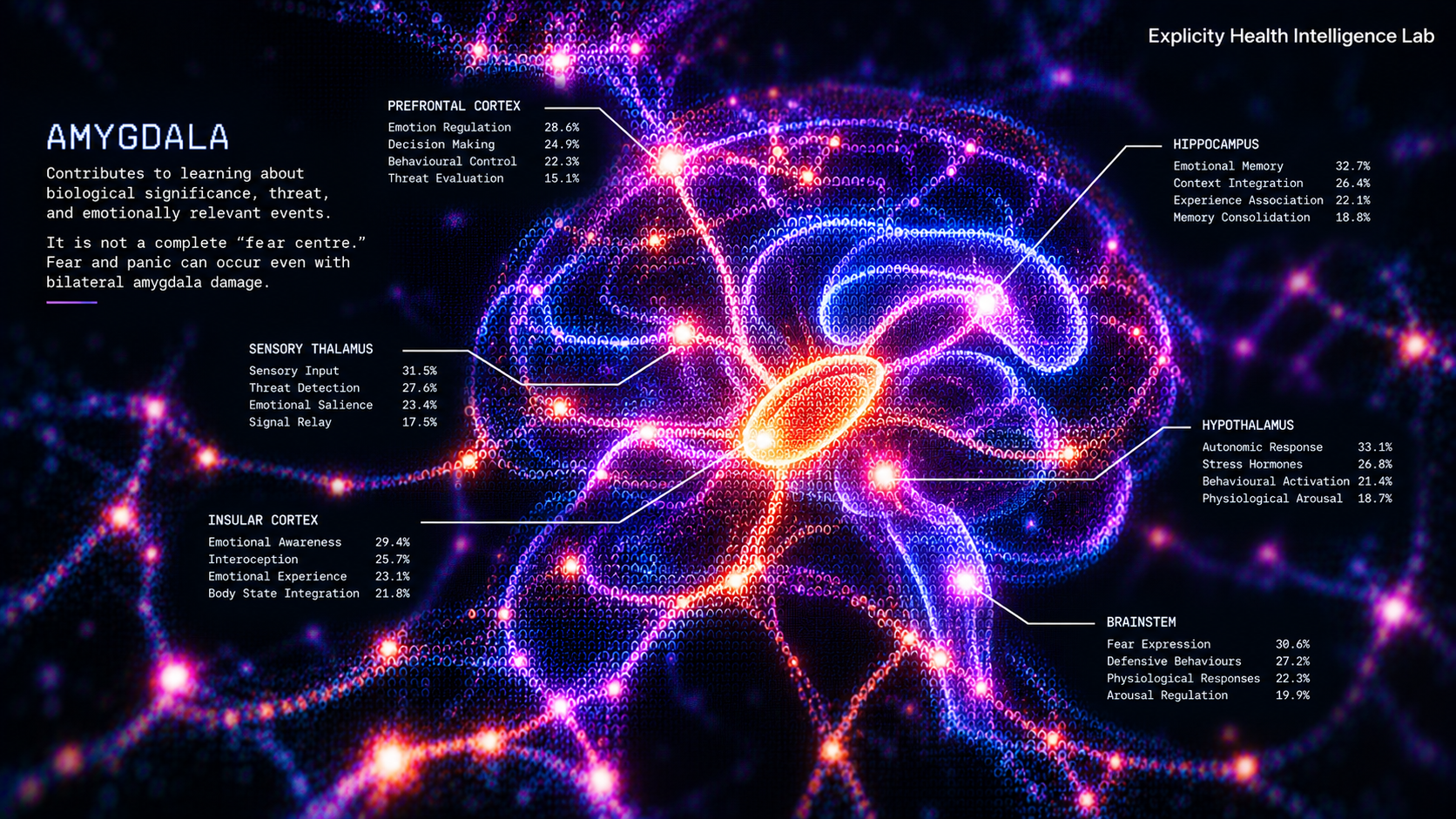
Brain-region descriptions identify important contributions, not exclusive ownership of a mental function. Each structure participates in wider networks, and a real task can recruit several systems at once. The supplied images are conceptual artworks; the percentages printed inside them are illustrative labels, not experimental measurements.
Explore connected brain systems
Frontal cortex
Frontal cortical systems contribute to planning, maintaining goals, working memory, movement and cognitive control through interactions with other regions.
This schematic is for orientation, not anatomical localisation. The named structures interact; the markers do not define precise region boundaries.
Region 01
Cerebral cortex
Location & anatomy. The folded outer layers of the cerebrum, organised into many areas and broad lobes.
Known contributions. Supports perception, voluntary movement, language, reasoning, and other complex functions through specialised but interacting regions.
Connections. Cortical areas communicate with one another and with thalamic, basal ganglia, hippocampal, cerebellar, and brainstem systems.
Everyday example. Recognising a familiar object can recruit visual, memory, language, and action-related networks together.
Limit of the shorthand. A lobe is not a single-purpose module. Local specialisation exists, but everyday cognition depends on distributed activity.
Open question. How do specialised representations coordinate into a stable, useful perception?
Region 02
Temporal cortex
Location & anatomy. Cortical regions along the sides of the brain, including auditory and ventral visual areas.
Known contributions. Contributes to auditory processing, aspects of language comprehension, object and face recognition, and memory-related functions, depending on subregion.
Connections. Temporal areas interact with frontal language and control systems, visual cortex, hippocampal memory systems, and other cortical networks.
Everyday example. Understanding a familiar voice in a noisy room combines sound analysis, attention, language and stored knowledge about the speaker.
Limit of the shorthand. The temporal lobe is not a single language or memory centre; functions are distributed and task-dependent.
Open question. How do auditory, visual and memory signals combine to support recognition across changing contexts?
Region 03
Frontal cortex
Location & anatomy. Cortical regions at the front of the cerebrum, containing motor, premotor and prefrontal areas.
Known contributions. Contributes to voluntary movement, planning, maintaining goals, working memory, flexible behaviour and decision-making through distinct interacting areas.
Connections. Frontal regions communicate with parietal, temporal and sensory cortex, thalamus, basal ganglia, hippocampus and amygdala.
Everyday example. Planning a route while adapting to a closed street involves goals, working memory, spatial input and action selection.
Limit of the shorthand. Frontal functions are not confined to one executive centre; subdivisions contribute differently within wider circuits.
Open question. How do frontal systems maintain a goal while updating action as circumstances change?
Region 04
Occipital cortex
Location & anatomy. Cortical areas at the rear of the brain, including primary and extrastriate visual regions.
Known contributions. Contributes to processing visual features such as orientation, colour, motion and form, with signals distributed to other visual systems.
Connections. Occipital regions interact with thalamic pathways and temporal and parietal visual networks through feedforward and recurrent communication.
Everyday example. Following a moving ball uses visual motion processing together with attention and movement-related predictions.
Limit of the shorthand. Vision is not completed in the occipital lobe; recognition, context and action involve broader networks.
Open question. How does activity across visual pathways support stable perception as the eyes and world move?
Region 05
Parietal cortex
Location & anatomy. Cortical areas along the upper and rear portions of the cerebral hemispheres, with multiple subdivisions.
Known contributions. Contributes to spatial processing, sensory integration, attention and the coordination of perception with action.
Connections. Parietal areas exchange information with visual, somatosensory, frontal and subcortical systems.
Everyday example. Reaching for a cup combines its visual location with body position and ongoing movement feedback.
Limit of the shorthand. Spatial attention and sensory integration are distributed functions; a single parietal area does not act alone.
Open question. How are sensory and body-centred coordinates reconciled during flexible action?
Region 06
Prefrontal cortex
Location & anatomy. Frontal cortical areas, with multiple subdivisions and long-range connections.
Known contributions. Contributes to maintaining goals, applying rules, planning, flexible behaviour, working memory, and cognitive control.
Connections. Its activity is shaped by reciprocal connections with sensory cortex, parietal regions, hippocampus, amygdala, thalamus, and basal ganglia.
Everyday example. Keeping a multi-step recipe in mind while adjusting to an unexpected missing ingredient uses goals, memory, and feedback.
Limit of the shorthand. There is no independent ‘central executive’ in one spot; prefrontal contributions depend on task and wider networks.
Open question. How do goals remain stable while behaviour stays flexible to new information?
Region 07
Hippocampus
Location & anatomy. A medial temporal structure with subregions including dentate gyrus, CA fields, and subiculum.
Known contributions. Helps form relationships among elements of experience, supports episodic memory, and contributes to aspects of spatial navigation.
Connections. It receives processed cortical information through the entorhinal region and communicates with distributed cortical and subcortical systems.
Everyday example. Remembering who sat beside you, where you were, and what was said at a lecture involves linked details, not a single stored picture.
Limit of the shorthand. It is not a permanent archive for every memory. The changing contribution of hippocampal and cortical systems remains under study.
Open question. How do neural systems support remembering an event and imagining a possible future?
Region 08
Amygdala
Location & anatomy. A collection of nuclei in the medial temporal lobe, connected with sensory, memory, and regulatory systems.
Known contributions. Contributes to learning about biological significance, threat, safety, and emotionally relevant events, and can modulate memory.
Connections. Interactions with sensory cortex, hippocampus, prefrontal areas, hypothalamus, and brainstem link information with bodily responses.
Everyday example. A sound associated with danger may later draw attention quickly, although context can change how it is interpreted.
Limit of the shorthand. It is not a ‘fear centre’; emotion and fear-related behaviour involve wider circuits and body systems.
Open question. How do context and past experience shape whether a signal is treated as important or safe?
Region 09
Thalamus
Location & anatomy. A set of nuclei deep in the brain, with distinct connections and functions.
Known contributions. Routes and transforms much sensory information and helps coordinate communication between cortical areas.
Connections. Different nuclei connect to different cortical and subcortical circuits; some participate in attention and state regulation.
Everyday example. Visual signals travel through thalamic pathways on the way from the retina toward visual cortex.
Limit of the shorthand. The thalamus is not a passive relay. Its varied nuclei are still being investigated and do not all perform one task.
Open question. How does thalamic activity coordinate communication as attention and task demands change?
Region 10
Cerebellum
Location & anatomy. A densely folded structure at the back of the brain, connected with motor and non-motor systems.
Known contributions. Its role in movement coordination, timing, motor learning, and error correction is well established; cognitive and affective contributions remain an active area of study.
Connections. It communicates with cerebral systems through loops that include the thalamus and with brainstem pathways.
Everyday example. Practising a tennis serve lets movements become more coordinated as predictions and sensory feedback are refined.
Limit of the shorthand. Proposed roles beyond motor control should be described as developing evidence, not settled explanations.
Open question. Which cerebellar computations generalise across movement, thought, and affect?
Region 11
Basal ganglia
Location & anatomy. A group of interconnected subcortical nuclei, including striatal and pallidal structures.
Known contributions. Participates in action selection, movement regulation, reinforcement-related learning, and habits.
Connections. Loops link cortex, basal ganglia, thalamus, and midbrain dopamine systems.
Everyday example. With practice, selecting a familiar sequence of actions can demand less deliberate step-by-step control.
Limit of the shorthand. Their pathways are more complex than a simple ‘go versus stop’ switch, and learning is not explained by dopamine alone.
Open question. How do parallel loops help select actions while learning from uncertain outcomes?
Region 12
Hypothalamus
Location & anatomy. A small region beneath the thalamus, linked with pituitary and autonomic systems.
Known contributions. Helps regulate homeostasis, temperature, hunger, thirst, circadian processes, endocrine activity, and bodily responses.
Connections. It integrates internal signals and communicates with autonomic, endocrine, limbic, and brainstem circuits.
Everyday example. Changes in hydration can influence thirst, attention to water, and physiological responses together.
Limit of the shorthand. These functions are distributed across specialised nuclei and partner systems, not a single control dial.
Open question. How are internal needs combined with external goals to shape behaviour?
Region 13
Brainstem
Location & anatomy. The midbrain, pons, and medulla connect the forebrain with the spinal cord.
Known contributions. Supports breathing and cardiovascular regulation, arousal, sleep-wake processes, and communication between brain and body.
Connections. Ascending and descending pathways link brainstem nuclei with spinal, autonomic, thalamic, and cortical systems.
Everyday example. A sudden sound can change arousal and orienting through rapid pathways before a person has fully identified it.
Limit of the shorthand. The brainstem is not merely a primitive relay; its many nuclei support vital and modulatory functions.
Open question. How do brainstem signals regulate large-scale brain state and conscious access?
Region 14
Insula
Location & anatomy. A cortical region folded within the lateral sulcus, with connections to sensory and limbic networks.
Known contributions. Contributes to interoception, integration of bodily signals, salience processing, and aspects of emotional experience.
Connections. Its networks link bodily state with cingulate, prefrontal, sensory, and autonomic systems.
Everyday example. Noticing a racing heartbeat while preparing to speak can influence how a situation feels and what action seems appropriate.
Limit of the shorthand. It does not produce emotion on its own; interpreting its activity requires task and network context.
Open question. How does the brain combine bodily signals with expectations and social context?
Chapter 04 · Sensory processing & perception
Seeing is more than receiving light
Vision begins when light reaches the retina, where rods and cones transduce light into neural signals. Retinal circuits already transform the input before it travels through the optic nerve and pathways involving the thalamus toward visual cortex. Processing continues across networks that contribute to edges, colour, motion, form, attention, recognition, and visually guided action.
Perception is neither a perfect copy nor an arbitrary invention. The nervous system combines evidence from the current scene with context and learned expectations. Visual illusions are useful because they reveal how ordinary perceptual rules behave under carefully arranged conditions. A line, shade, or object may look different when its surrounding context changes, even while the physical stimulus remains constant.
Interactive demonstration · simultaneous contrast
Does context change what the same colour looks like?
The central targets use exactly the same CSS colour. Surrounding luminance can change their apparent contrast. This simple demonstration illustrates context; it does not reproduce every stage of biological vision.
Recognising a cup involves more than detecting its outline: viewpoint, lighting, prior experience, attention, and possible actions all contribute. Recurrent communication means information can influence earlier processing as well as later interpretation. Conscious perception is therefore not identical to the first sensory response recorded in a pathway.
How the brain recognises a familiar face
What happens. Light reflected from a face reaches the retina, where photoreceptors and retinal circuits transform it into neural signals.
Systems involved. Rods, cones, retinal interneurons and retinal ganglion cells.
What scientists understand. Retinal output already reflects contrast and other transformations.
What remains uncertain. How these signals combine with expectations varies with context and remains an active area of study.
This sequence simplifies a parallel, recurrent process. It does not represent every neural computation or imply that recognition follows one fixed route.
A familiar face recruits a network
Regions contribute different information while communicating with one another. The diagram is a conceptual map, not a measured connectivity result or a claim that these are the only areas involved.
Chapter 05 · Encoding, consolidation & retrieval
How the brain remembers
Memory is a collection of interacting processes rather than one storage location. Sensory traces can persist briefly; attention determines which information receives further processing. Working memory keeps information available for an ongoing task, while episodic memory concerns personally experienced events, semantic memory supports general knowledge and meaning, and procedural learning supports skills and habits.
Working memory is not a biological RAM module
Working memory lets a person hold and manipulate information relevant to the task at hand. It depends on attention and control, has limits, and is vulnerable to interference. Evidence supports multiple mechanisms, including sustained activity and states in which information can remain available without continuously measurable activity in the same form. The computer analogy can help name a temporary function, but it is not a literal anatomical equivalence.
Events, knowledge, and skills rely on interacting systems
Episodic recollection links event details with place, time, and personal context. The hippocampus is important in forming relational memories, while cortical representations are distributed. Semantic knowledge—facts, concepts, and word meanings—is likewise supported across multiple systems. Practice can produce procedural learning, including changes in movement and habits, with contributions from motor, cerebellar, and basal ganglia circuits depending on the task.
Consolidation and retrieval
Synaptic consolidation describes processes that stabilise changes at cellular connections. Systems consolidation describes changing interactions among hippocampal and cortical networks over time; it should not be imagined as a complete file being copied from one brain region to another. Sleep is associated with neural reactivation and memory processing, but the effects vary by task and memory system; see, for example, Wilson and McNaughton’s hippocampal ensemble study ↗. Retrieval depends on cues and context and can reconstruct an event using current knowledge. Forgetting can reflect interference or access difficulty as well as loss; recalling does not alter every memory in the same way.
Interactive Memory Architecture · In Vivo vs. In Silico
How the brain remembers: biological plasticity vs digital storage
Inspect how biological neural networks encode, consolidate, and reconstruct memories through living biochemical circuits, contrasted against the static matrix mechanics of digital databases.
A student attends their first college lecture
Attention
In a busy first lecture, attention selects a classmate’s name or an unusual room detail. Competing sounds can be missed.
Select a process to explore how it contributes to the same remembered event.
Conceptual relationship diagram; memories do not all follow the same route or sequence.
An everyday example: the first day at college
On a first day, attention selects some details from a crowded stream: a building entrance, a classmate’s name, the route to a lecture hall. Existing knowledge helps interpret unfamiliar signs. Emotional relevance may make a conversation or moment of uncertainty especially noticeable. Later, rest and repeated encounters can support stabilisation, but there is no guarantee that every detail is preserved.
Months later, a photograph, a familiar route, or a friend’s story may cue recollection. The person may accurately remember central parts while reconstructing peripheral details from later knowledge. This example separates encoding, consolidation, cue-dependent retrieval, and reconstruction without assuming that memory is a perfect recording.
Questions about memory
Which features of an event are preserved over time? How do cues make one memory accessible and another difficult to retrieve? When does reactivation create an opportunity for change? How can an experiment distinguish loss of information from a failure to access it?
Chapter 06 · Practice, feedback & transfer
The brain that changes through experience
Learning depends on experience, attention, memory, feedback, plasticity, and behaviour. Associative learning links events; reinforcement learning studies how actions relate to outcomes; observational learning uses information gained by watching others; concept formation groups examples into useful relationships. Error-based learning compares an outcome with an expectation and can guide adjustment.
Repeated practice can improve performance, but repetition does not cause an identical change each time. Spacing practice across time, retrieving information from memory, useful feedback, motivation, and prior knowledge can all affect retention. Learning something briefly, remembering it later, and transferring it successfully to a new situation are different outcomes and should be measured separately.
Learning a musical instrument
A beginner learning piano initially attends to finger position, notation, rhythm, and sound as separate demands. Slow practice makes errors easier to detect. Feedback from hearing a note and feeling a movement helps refine timing and coordination. With experience, familiar patterns can be performed more fluently, leaving attention available for expression or a new passage. Progress depends on practice quality and context; it is not a simple linear accumulation of repetitions.
Learning mathematics
A learner may first memorise a procedure, then connect it to a visual model and to the reason it works. Comparing worked examples can expose a misconception; attempting a new problem reveals whether the concept transfers. Corrective feedback can guide attention toward the error, while later retrieval helps test whether the idea remains available. A high score on a practised exercise alone does not prove broad understanding.
Sleep, attention, motivation, feedback, and prior experience influence different parts of learning. Research asks how those factors interact and for whom a particular practice strategy works; no one method improves every skill in every situation.
Learning from an error
A person learning an instrument compares intended sound and movement with sensory feedback. Select each stage in this simplified teaching model.
The player intends a particular note, rhythm and movement.
Simplified model of error-based learning, not a complete account of motor learning.
Teaching Visualizations · Qualitative Curves
Read the shape, not a statistic
Scientific models communicate through curve dynamics: sigmoidal consolidation, logarithmic decay, drift diffusion, and inverted-U boundaries. Compare biological cognitive dynamics against algorithmic AI approximations.
Chapter 07 · Value, motivation & choice
How emotion shapes thought
Cognition and emotion are closely connected. Emotional learning changes what attracts attention; reward-related information can guide motivation; bodily signals can contribute to how a situation feels; and cognitive control can help maintain a goal when another action is tempting. Stress effects vary with intensity, duration, timing, controllability, and the task being performed.
Dopamine contributes to learning and motivation in several circuits. In some settings, activity in dopamine neurons relates to differences between expected and obtained rewards. This is one important finding, not a universal explanation for dopamine activity or a reason to call dopamine simply the brain’s happiness chemical.
Choosing between competing goals
Imagine deciding whether to spend an evening preparing for an exam or helping a family member with an urgent task. Memory supplies relevant history; attention prioritises immediate details; emotion signals importance; expected outcomes and uncertainty shape value; social commitments add context. A decision emerges from their interaction. There is no single decision-making centre that calculates every choice alone.
Individual differences, available resources, social surroundings, and current bodily state can all change how options are evaluated. Studying decisions therefore requires both precise experimental tasks and care when generalising them to everyday life.
Study for the exam or attend a social event?
Change the circumstances to see which considerations become relevant. This does not calculate a correct answer: people weigh goals and context differently.
- An imminent exam may make the study goal more salient.
- Prior experience, uncertainty, attention, emotion, expected outcomes and cognitive control also shape the choice.
How the brain rests, focuses, and becomes aware
Attention is selective and limited
Selective attention prioritises some information over competing information; sustained attention maintains focus over time; divided attention attempts to coordinate multiple demands. Attention affects what is noticed, processed, and learned.
Rapidly switching between demanding tasks can impose costs because selection and goal maintenance take time. The size of those costs depends on task structure and the person’s state. Unattended information is not necessarily absent from processing, and its effect varies with its strength, relevance and context.
How the brain filters competing information
Choose an input to see which signal receives attentional priority in this simplified example.
Selected input: Lecture. Words and visual cues related to the task
A familiar attention example
A student tries to follow a lecture while a phone lights up with messages. Attention may shift toward the notification; the student can miss a sentence, use notes or context to reconstruct it, then return to the lecture.
This connects selective attention, working memory, task switching and later recall. It does not imply a single universal switching penalty or explain subjective awareness.
Following a lecture while the phone lights up
These two response windows separate a controlled cognitive account from an everyday scenario. On desktop, each window scrolls independently; on smaller screens, both return to natural document scrolling.
Sleep and biological timing
Sleep alternates through non-rapid-eye-movement and rapid-eye-movement stages across the night. Circadian rhythms help time sleep and wakefulness; sleep pressure builds with time awake. These processes interact with brain state and performance.
Sleep is associated with memory processing, including reactivation of some patterns, but benefits differ among tasks and memory systems. Sleep serves multiple functions and cannot be reduced to memory consolidation alone.
Sleep architecture across an illustrative night
Select a point on the graph or a time segment below to inspect this illustrative sleep-stage sequence.
~0.0 h · Wake. Wakefulness can occur before sleep and briefly between sleep periods. Brief awakenings may not always be remembered.
The hypnogram is categorical: the vertical position names a stage rather than measuring an amount of sleep. It is a teaching sketch of changing stage architecture, not a score or clinical record.
Awareness and consciousness
Wakefulness describes a level of arousal; awareness concerns information available to an organism; conscious access concerns information that can guide report or deliberate use; subjective experience is the felt quality of seeing red or hearing a melody. These distinctions help formulate experiments, but no current account resolves the relationship between neural activity and subjective experience.
Global neuronal workspace theory and integrated information theory are prominent, competing frameworks. They make different proposals about the conditions and neural organisation associated with consciousness. They should be treated as testable theories with disputed predictions, not as settled explanations.
Relationships that matter for conscious access
Arousal. Arousal describes a general level of wakefulness and responsiveness; it is related to, but not identical with, awareness of a particular stimulus.
Chapter 09 · Biological & computational systems
The brain and the computer
Brains and computers both transform inputs and can use prior information to shape later outputs. That functional resemblance can guide precise questions. Their physical components, architectures, learning processes, and constraints differ.
Interactive comparison · qualitative, no benchmark values
Explore one difference at a time
Choose a dimension to compare the biological brain with a computer or artificial model. These are explanatory contrasts, not a claim that either system has one simple counterpart.
BIOLOGICAL SYSTEM
The biological brain
Basic units
Diverse living neurons and non-neuronal cells interact through electrical and chemical processes.
COMPUTATIONAL SYSTEM
Computers & artificial models
Basic units
Transistors implement logic; processors execute instructions. An artificial neuron is a mathematical operation.
Example · Basic units
When you recognise a melody, living cells with different shapes, connections and chemical states participate. A computer carries out operations through designed hardware and software components.
A biological neuron is not an artificial neural-network unit, a synapse is not simply a trainable weight, the hippocampus is not an SSD, and working memory is not literal RAM. These analogies may suggest questions, but they do not demonstrate shared mechanisms. Equally, rejecting every analogy would miss meaningful shared problems such as limited resources, interference, and adaptation.
Biological and artificial neurons are different kinds of systems
A person learning an instrument
Practice, sensory feedback, goals, sleep, prior experience and bodily context shape changing skill. Memory and movement adapt over multiple interacting timescales.
A model trained on examples
A data stream, target labels, loss function and optimiser define an engineering task. Parameters change according to the training procedure; evaluation tests generalisation to selected new examples.
The comparison identifies differences in experience, feedback, memory, training objectives and generalisation. The processes are not identical.
Chapter 10 · Models & continual learning
Neural networks and artificial intelligence
Three levels should remain distinct: hardware such as a CPU, RAM, SSD, or GPU; system software that allocates resources; and an application or model that performs a task. An AI model is not a CPU. Its parameters are not the same as all memory installed in a computer.
A simplified artificial unit calculates a weighted sum of inputs and applies an activation function: z = Σᵢ wᵢxᵢ + b; a = f(z). During supervised training, a loss measures disagreement with targets, backpropagation calculates gradients, and an optimiser updates parameters. This is an engineering procedure, not a complete model of biological learning.
How a model learns to classify an image
Input image. A small illustrative image enters the task.
This simplified supervised-learning pipeline is not a complete account of machine learning or biological vision.
What shared vocabulary does not prove
Transformer attention calculates relationships among query, key, and value vectors. Its name does not establish that it reproduces human attention or gives a model conscious awareness. Computer-vision systems can perform well on image tasks without using the same mechanisms as human vision. Similar words and outputs are not evidence of identical processes.
Continual learning and forgetting
When a neural network learns from a sequence of tasks, updating parameters for later data can interfere with earlier capabilities—a problem called catastrophic forgetting. Methods include replaying stored examples, regularising changes to selected parameters, distillation, architectural changes, and approaches that try to maintain plasticity. Existing work already shows that replay can help in particular settings; the useful research question is specific to data, buffer, schedule, architecture, and update budget.
Biological replay during sleep and artificial experience replay share a broad idea of reusing earlier activity or examples. The word “replay” does not make the mechanisms equivalent. Human memory consolidation involves living circuits, bodily state, neuromodulation, and multiple timescales; a computational buffer is an explicit engineering choice.
A small image-classification model
In a supervised image task, an input image is represented numerically and passed through a network. The model produces a prediction; training compares it with a supplied label, calculates a loss, and updates parameters. Evaluation on new examples asks whether useful patterns generalise beyond the training set. This is a simplified learning account: real pipelines also depend on data preparation, model architecture, optimisation and evaluation design.
A tiny image-feature classifier
This lightweight model receives two illustrative image features, passes them through two hidden units and returns a probability for “pattern A.” Choose an example or adjust an input and a connection weight.
Output probability: 0.62 · predicted result: pattern A
The hand-set weights and two invented features make this a transparent arithmetic demo, not a trained vision model. It does not perceive images or model biological vision.
A person learning an instrument
Practice, sensory feedback, goals, sleep, prior experience and bodily context shape changing skill. Memory and movement adapt over multiple interacting timescales.
A model trained on examples
A data stream, target labels, loss function and optimiser define an engineering task. Parameters change according to the training procedure; evaluation tests generalisation to selected new examples.
The comparison identifies differences in experience, feedback, memory, training objectives and generalisation. The processes are not identical.
Explicity Research Assistant · 11 · Evidence & Methods
How scientists study the brain
OBSERVE BRAIN ACTIVITY
Functional MRI (fMRI)
Measures changes in blood-oxygenation-related signals. It can map task-associated activity across the brain, but the signal is indirect and slower than neural spikes.
Electroencephalography (EEG)
Records electrical potentials at the scalp with fine timing. Signals mix sources and are difficult to localise precisely.
Magnetoencephalography (MEG)
Measures magnetic fields associated with neural currents, with millisecond timing and source-estimation limits.
Single-neuron recordings & electrophysiology
Measure electrical activity from individual cells or populations, often with high temporal detail; sampling is local and recording access is constrained.
TEST BEHAVIOUR & CAUSAL CONTRIBUTIONS
Lesion studies
Use the effects of naturally occurring or clinical brain damage to infer contributions. Lesions can affect connected systems and rarely isolate one computation perfectly.
Behavioural experiments
Measure choices, reaction times, accuracy, and reports under controlled conditions. Task design and participant strategy affect interpretation.
Neuropsychological assessment
Characterises changes in cognition after injury or disease using structured tasks; profiles vary and do not map one-to-one to single regions.
Computational modelling
Tests whether a formal system can reproduce selected observations and generates predictions. A successful model is not automatically a complete biological explanation.
Non-invasive brain stimulation
Perturbs activity in selected ways to test causal contributions, with limits in targeting, individual response, and interpretation.
Strong explanations combine methods where possible. Correlation between brain activity and a task does not by itself prove that the activity caused the behaviour. Causal claims need designs that rule out plausible alternatives and describe their limits.
Worked example: testing familiar-face recognition
A study might show participants familiar and unfamiliar faces while collecting accuracy and response-time measures, then compare task-related fMRI signals. Researchers could use EEG in a separate or compatible protocol to ask when responses differ. The behavioural measure says what participants did; fMRI offers an indirect spatially detailed signal; EEG offers timing with source-localisation limits. Neither scan alone proves that one region “recognised” a face. A careful report specifies stimuli, familiarity checks, exclusions, analysis choices and uncertainty, then limits its conclusion to the tested conditions.
Chapter 13 · Explicity research programme
From careful questions to stronger evidence
The accompanying manuscript proposes a narrow computational study about the timing of experience replay. Existing research already supports replay as a method in artificial continual learning, so the broad claim that “replay helps” is not presented as a new discovery. The candidate contribution is a controlled comparison under recurring classes and limited memory; a focused literature audit must establish whether that exact comparison is novel.
Proposed research question
Under equal replay-buffer capacity and equal training-update budgets, how does replay after each incoming batch compare with periodic replay bursts on class-incremental and recurring-class image streams?
The manuscript’s hypothesis predicts an interleaved-replay advantage in the specified recurring-class setting. It is a hypothesis, not an observed result and not a prediction about biological sleep.
Proposed computational protocol
Use Fashion-MNIST with fixed training, validation, and test partitions and a small multilayer perceptron. Construct class-incremental and recurring-class streams. Compare sequential learning, extra updates on current data, interleaved replay, and periodic burst replay. Test buffer capacities of 200 and 1,000 examples, with ten paired random seeds per condition. The manuscript estimates 120 planned runs across the non-duplicated conditions; this is a protocol count only. Training has not been performed.
Hold initialisation, stream order, replay-buffer update rules, total training updates, and replay example presentations constant where the comparison requires it. Exclude test data from tuning. Evaluate repeatedly during learning, including immediately before and after bursts, so final accuracy does not hide temporary decline or recovery.
Outcomes and decision rules
The primary outcome is average ten-class test accuracy at recurring-stream checkpoints after the first complete class cycle with the smaller buffer. Secondary outcomes include final accuracy, learning trajectories, forgetting, adaptation, pre-burst/post-burst change, runtime, and peak memory. Measure energy only with a documented method. Report one paired difference per seed, the mean, every run-level difference, and a 95% confidence interval.
The source manuscript proposes a two-percentage-point practical threshold for this particular study; it is a declared criterion, not a universal standard. An interval entirely above or below the threshold would favour one schedule in this setting; an interval within it would be consistent with practical similarity under the criterion; a wide interval spanning both directions would be inconclusive.
Proposed study · no results yet
How learning curves might be compared
This experiment uses public non-clinical product images. It does not model biological sleep, neural anatomy, consciousness, or human memory, and it does not establish clinical usefulness. Equal update counts do not guarantee equal wall-clock time or energy. Seeds are repetitions of a computational experiment, not human participants.
Chapter 14 · Explore the ideas
A few useful ways to explore
The neuron diagram above traces one simplified direction of signalling. The visual-contrast demonstration changes only the surrounding luminance, leaving both centre patches the same colour. These are explanatory tools: they make selected relationships easier to notice without claiming to reproduce the full biological system.
Use the chapter index to move between scales, then compare the language used for biological and computational mechanisms. The most useful question is often not “which one is smarter?” but “what precisely is being measured, under what conditions, and what would count as evidence?”